![GMG Logo [white]](https://greatermediagroup.net/wp-content/uploads/2025/06/GMG-Logo-white-300x168.png)

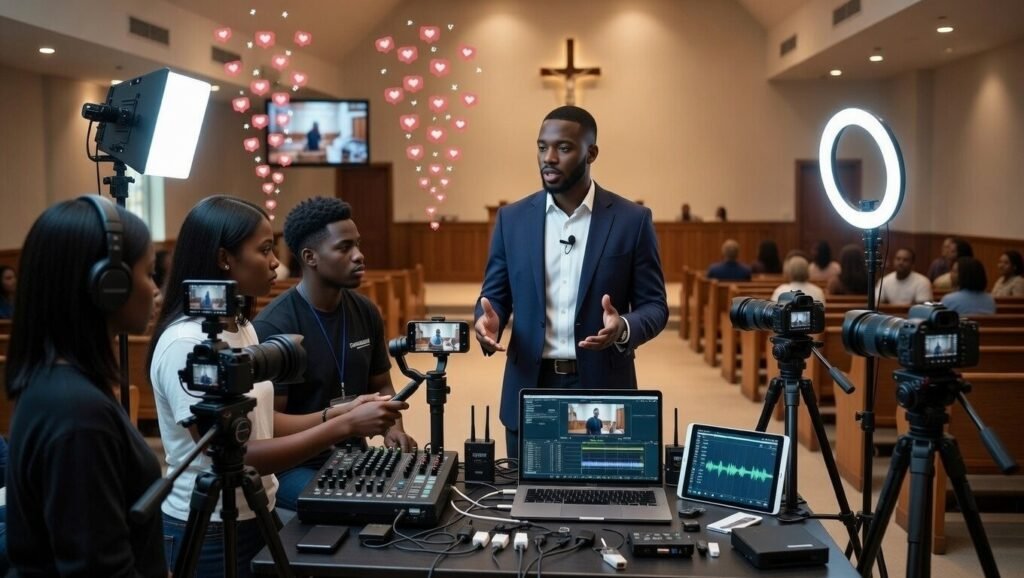
How to build an effective church media team has become an urgent conversation for churches navigating today’s digital generation. Church media is no longer an optional department or a group of volunteers managing equipment’s, It has become one of the most influential ministries within the life of the church. For many people, the first encounter with a church does not happen at the entrance door on Sunday morning. It happens online. It may be through a livestream, a sermon clip shared on Instagram, a worship moment on TikTok, or a church announcement seen on Facebook.
This shift means one thing: the church media team is no longer just handling equipment. They are shaping first impressions, strengthening discipleship, and expanding the reach of the gospel beyond physical walls.
However, building an effective church media team requires more than gathering a few people who know how to operate a camera. It requires vision, structure, intentional leadership, proper training, and a healthy culture that sustains long-term growth.
If your church desires consistency, excellence, and real impact through media, this guide will help you build a team that functions effectively and grows sustainably.
Practical Steps On How To Build An Effective Church Media Team
Defining the Vision of the Media Ministry
Before recruiting anyone, leadership must first answer a foundational question: Why does our church need a media team?
Without clarity, volunteers may join with different assumptions. Some may think the goal is simply to livestream Sunday services. Others may believe it is only about social media promotion. When vision is undefined, direction becomes scattered.
An effective church media team begins with a clearly articulated purpose. For example, a church may define its media mission as communicating the message of Christ clearly, creatively, and consistently across both physical and digital platforms. That statement immediately elevates the media from a technical duty to a ministry assignment.
Consider the difference vision makes. A church that views media as digital evangelism will prioritize sermon snippets, online prayer engagement, and midweek encouragement. Meanwhile, a church that sees media merely as event promotion will mostly post flyers. The clarity of vision determines the quality and type of output.
When volunteers understand the spiritual purpose behind what they are doing, they serve with greater commitment and intention.
Creating Clear Roles and Responsibilities
One of the most common mistakes churches make is assuming that passion alone will create order. In reality, structure creates sustainability.
Even in small churches, clearly defined responsibilities prevent confusion and burnout. There should be someone coordinating the overall media operations. Someone should oversee audio quality. Someone should monitor livestream software. Someone should manage social media posting and engagement. In larger teams, additional roles such as video editor, photographer, or graphic designer may exist.
Imagine a Sunday service where one person is trying to operate the camera, monitor sound, manage slides, and post live updates simultaneously. The pressure alone can cause errors. Now imagine the same service with assigned roles. The camera operator focuses solely on framing. The sound technician monitors clarity. The social media manager captures moments for later posts. The entire experience becomes smoother and more professional.
Structure is not about hierarchy. It is about clarity. When each person understands their responsibility, teamwork improves and stress decreases.
Recruiting the Right People
It is tempting to recruit only individuals who already have technical experience. While skills are valuable, character is foundational.
An effective church media team should be built on reliability, humility, consistency, and a willingness to grow. A highly skilled volunteer who lacks discipline can disrupt the entire team dynamic. On the other hand, someone who is faithful and teachable can develop exceptional skills over time.
For example, a young church member who consistently shows up early, stays attentive during training, and asks thoughtful questions may initially lack experience. Yet within months, that same individual could become a dependable editor or camera operator because of their commitment to learning.
The media ministry represents the church publicly. It requires spiritual maturity alongside technical competence. When character forms the foundation, skill development becomes a natural progression.
Establishing Training and Systems
Many churches unintentionally set their media teams up for frustration by assuming volunteers will simply “figure things out.” While observation and practice are helpful, structured guidance accelerates growth.
Training does not have to be complicated. Even a short orientation session explaining camera positioning, lighting basics, and audio monitoring can significantly improve output. Documented processes, such as how to set up livestream software or where to store recorded files, create consistency.
For example, imagine arriving for service only to realize the microphone batteries were not checked. Or discovering mid-service that the internet connection is unstable. These issues often result from a lack of systems rather than a lack of effort.
By establishing simple pre-service routines and clear operational steps, the media team gains confidence. Confidence reduces anxiety, and reduced anxiety improves performance.
Investing Wisely in Equipment

Excellence does not require the most expensive cameras on the market. It requires wise investment and proper usage.
One of the most overlooked aspects of church media is audio quality. platforms like youtube provide free trancing resources through their Creator Academy, which can help church media teams improve audio and video quality without expensive upgrade. Viewers may tolerate imperfect lighting or slightly lower video resolution, but they will quickly disengage if the message is unclear. Prioritizing clear sound should come before upgrading visual equipment.
For instance, a church using a mid-range camera paired with a strong audio setup and stable internet connection will often outperform a church using high-end visuals but poor sound clarity.
Lighting also plays a crucial role. Simple adjustments, such as ensuring the speaker’s face is well lit and avoiding harsh shadows, can elevate perceived professionalism dramatically.
The goal is not luxury. The goal is clarity. Start with essentials, master them, and upgrade gradually as growth allows.
Developing a Content Strategy
An effective church media team does not operate reactively. It plans intentionally.
Instead of scrambling for posts at the last minute, creating a monthly content plan provides direction and rhythm. If the church is teaching on faith for the month, social media content can reflect that theme through sermon snippets, reflective questions, and short devotionals.
For example, after a powerful Sunday message, a short clip highlighting a compelling statement can be scheduled for Monday. Midweek, a related scripture reflection can reinforce the theme. By Friday, a volunteer spotlight can humanize the community. This pattern keeps engagement steady rather than sporadic.
Planning also reduces stress within the team. When content is mapped out ahead of time, editing and design become intentional rather than rushed.
Consistency builds trust with your audience. Trust increases engagement.
you may like to explore our church media strategy guide
Creating a Culture of Feedback and Growth
No media team becomes effective without evaluation. Reflection fuels improvement.
After each service or campaign, short review discussions can help identify strengths and growth areas. Instead of assigning blame, the focus should remain on solutions.
For example, if livestream engagement decreased, the team can explore whether posting time influenced visibility. If viewers reported buffering issues, internet stability can be assessed. If sermon clips performed exceptionally well, that success can be analyzed and replicated.
Technology and digital behavior evolve constantly. A team committed to growth remains adaptable and relevant.
Preventing Burnout and Sustaining Momentum
Media volunteers often work behind the scenes, unseen by most of the congregation. They arrive early, troubleshoot technical issues, and leave after everyone else.
Without intentional care, burnout becomes inevitable.
Rotation systems allow team members to rest. Cross-training ensures that no single individual becomes indispensable. Public appreciation strengthens morale.
Imagine the impact of a pastor publicly acknowledging the media team and sharing how someone watched a service online and decided to visit the church in person. That recognition transforms routine tasks into visible ministry impact.
An effective church media team thrives in an environment of gratitude and shared responsibility.
Aligning Media With Church Leadership
For the media to function effectively, it must align closely with overall church leadership.
Regular communication between pastors and media coordinators ensures that sermon themes, event promotions, and messaging remain cohesive. When leadership shares sermon highlights or key illustrations in advance, the media team can capture and repurpose those moments strategically.
Alignment strengthens branding and reinforces clarity. It ensures that what is preached in the sanctuary echoes consistently across digital platforms.
Conclusion: Building With Purpose
Building an effective church media team requires more than enthusiasm. It requires vision, structure, training, investment, planning, evaluation, and appreciation.
When built intentionally, the media team becomes an extension of the pulpit. It carries the message beyond physical walls and into homes, workplaces, and communities.
In a digital generation, your church media team often creates the first impression people have of your ministry. When structured well and led intentionally, that first impression can lead to lasting impact.
Church media is not merely about cameras and content. It is about communicating Christ clearly, consistently, and creatively in a world that is constantly watching.